

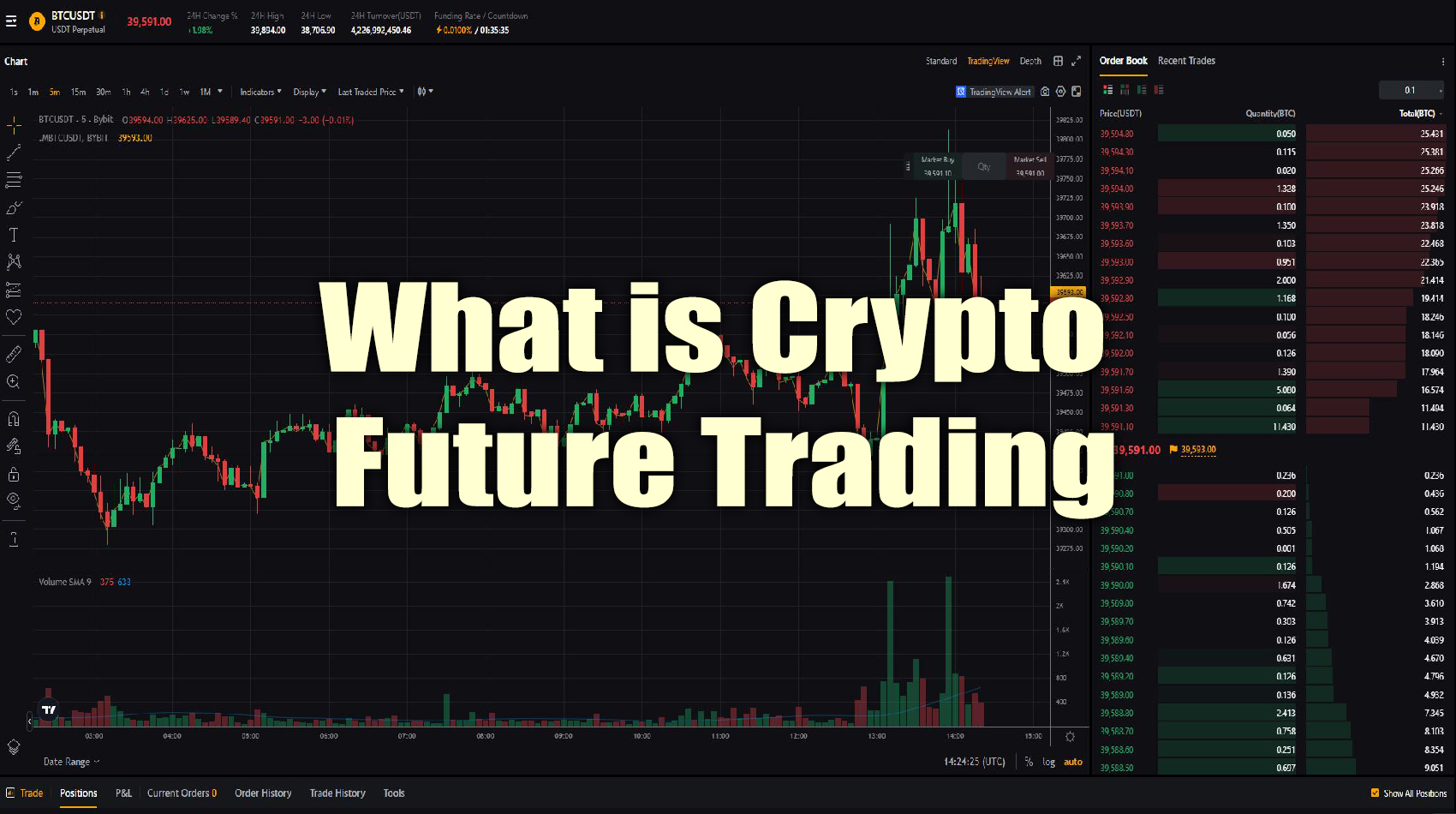
Do you want to Learn to do Future trading in cryptocurrencies or Perpetual trading but you don't know where to start?
Don't worry, in this guide I will show you the entire process step by step.
Now if you are in a hurry and want to register directly on the platform to trade, you can do so register on the weex exchange.
However, let's start with the basics.
Table of Contents
What is Futures Trading?

The future trading is a form of transaction in which investors agree to buy or sell an asset at a specific price.
In the context of cryptocurrencies, futures trading allows investors to “bet” on the price of a cryptocurrency at a future date, without having to actually own it.
There are two main types of cryptocurrency futures contracts: contracts long and short contracts.
Long contracts allow investors to bet that the price of a cryptocurrency will increase, while short contracts allow investors to bet that the price of a cryptocurrency will be reduced.
If you want to learn more details about how to do Future trading you can read the article below or do Registration on the MEXC exchange.
How to Start Futures Trading
Now what you need to do to start Future trading in cryptocurrencies is to find a platform so you can do it. Trading.
Personally, there are several platforms but for crypto trading I choose WEEX exchange or Bitunix exchange.
Then you will have to register with one of the two exchanges.
In the example of the article I will register at Weex exchange where you can register with an email or phone and get a 20% Bonus Deposit

Then to make a deposit you will go to the category Deposit and you will transfer the cryptocurrencies that are convenient for you.
For example Solana, USDT, USDC and other.

The next step you should take is to go to the category Future trading and then you will press the USDT M Futures.
Now to transfer the money you have, you will click on button that I show you in the picture and you will transfer the money from the Funding account to Future account.

The next step is to go to the category at the top right and select the Isolated or Cross.
The differences between these two are that for example the cross If you take a trade for $300 and start losing money and you haven't set a stop loss and your loss starts to exceed $300, then it will start to be withdrawn from your futures account if you have one.
The Isolated is that for example, if you have taken a trade for $200 and you have not set a stop loss, if it reaches a $100 loss, the trade will immediately go down and you will only lose the €100 you had invested.
Next, you will need to choose the leverage you will have for each trade you make.
However, because leverage confuses many people, let's look at it in more detail.
Basic concepts about leverage
Leverage is one of the most important concepts in cryptocurrency futures trading, as it allows investors to control larger market positions with less capital.
However, to read this guide you are probably a beginner, so what you should do is pay attention. very good leverage.
Why is leverage one of the better tools but if you don't know how to use it it could hurt you works destructively.
Let me explain it to you in a little more detail:
- Definition: Leverage is the use of borrowed funds from the trading platform to increase the size of your position. It is expressed as a ratio, e.g., 5x, 10x, or 100x.
- How does it work: With 10x leverage, if you invest €1.000, you can control a position worth €10.000. Profits or losses are calculated based on the total amount of the position.
- Example: If you open a long position on Bitcoin with €1.000 and 10x leverage, and the price of Bitcoin increases by 5%, your profit will be €500 (5% of €10.000), instead of €50 without leverage.
Leverage Management
Here you will see some basic steps you should take when starting Futures trading.
- Low Leverage: Start with low leverage (2x-5x) to reduce risk.
- Stop Loss: Set stop-loss orders to limit losses if the market moves against you.
- Position Calculation: Calculate your position size so that it does not exceed 1-2% of your total capital.
- Example: If you have €5.000 in your account, don't use more than €50-100 as margin on a position with 5x leverage.
Risks of Leverage
- High Risk: Leverage multiplies both profits and losses. A small market move against you can lead to large losses.
- Funding Rates: In perpetual futures, you pay or receive funding rates (debits or credits) depending on the direction of your position (long or short).
- Psychological Pressure: Leverage requires constant market monitoring, as rapid price movements can cause rapid liquidation.
How to place an order
After you have learned and understood in 100% what is leverage It's time to take your first Bitcoin trade.
The commands I personally use are two and they are as follows:
- Market Order: It is executed immediately at the current market price.
- Limit Order: You set a specific price at which you want to buy or sell.

Let me now show you a detailed example of how to do Future trading.
Initially I will put $500 with x4 leverage and the position will be $500 x4 = $200 and I will take a trade long.
The price of Bitcoin is for example at 100.000$ and the R/R is 2:1, meaning for every $1 you risk, you aim for a $2 profit.
Now if the price falls from $100.000 to $98.000, the loss is 2% of the position value $2.000 = $40.
However, if the price rises from $100.000 to $104.000, the profit is 4% of the value of the position, so profit 4% of $2.000 = $80.
What you should pay attention to if you bet real money is always risking it. 2% to 4% of your entire account.
For example, in $1000 for each trade you should risk it 4% max i.e. $40.
Stop loss & Take profit

In futures trading, Stop-Loss and Take-Profit are essential risk management tools that help traders limit losses and secure profits.
Here is a brief explanation:
Stop Loss (SL)
- Definition: An order that automatically closes your position when the price reaches a predetermined level, limiting losses.
- Purpose: Protects your capital from large losses, especially in conditions of high volatility or when using leverage.
- Example: In the scenario with $500 4x leverage ($2.000 position value), and an entry price of $100.000, you set your stop-loss at $98.000 (2% drop). If the price drops to $98.000, the position closes with a loss of $40 (2% of $2.000), plus fees (about $43,2 with WEEX fees of 0,08% as taker).
Take Profit (TP)
- Definition: An order that automatically closes your position when the price reaches a predetermined profit level.
- Purpose: Secures your profits before the market reverses, avoiding greed that can lead to losses.
- Example: In the same scenario, you set your take-profit at $104.000 (4% upside, R/R 2:1). If the price reaches that level, the position closes with a profit of $80 (4% of $2.000), or $76,8 after WEEX fees.
My opinion
The future trading in cryptocurrencies It is an exciting but also high-risk opportunity for investors who want to take advantage of market volatility.
Personally, I believe it offers unique earning potential, especially with the use of leverage, but it requires deep understanding, discipline and risk aversion.
The ability to speculate on both both upward and downward movements is attractive, but beginners often underestimate the risks, such as liquidation due to sharp fluctuations.
With proper risk management, such as stop-loss and low leverage, futures trading can be a powerful tool.
Disclaimer:
What we mention on the website Bitsounisproject is for educational and entertainment purposes, does not constitute investment advice.
The above links to the services mentioned may be affiliate links.

